Download the free printable
Download PDF (2 pages) Download PNG preview
US Letter, 8.5 x 11 inches. Print at 100% for craft pieces; use Fit to page if your printer clips the margins. An adult should help with scissors and fitting wearable crafts.
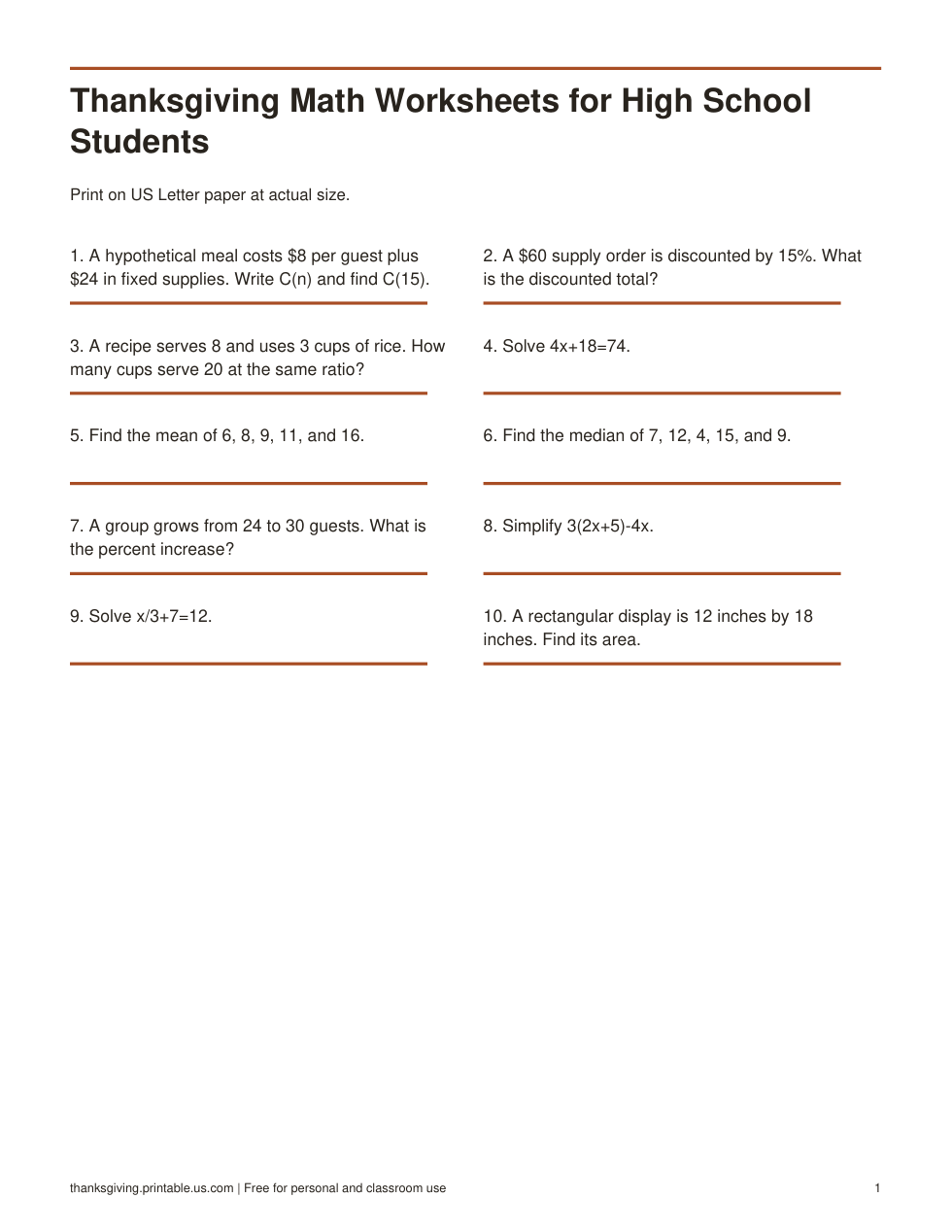
A Thanksgiving context can make high school math practice feel concrete without replacing the mathematics with decoration. This worksheet uses an imaginary gathering to explore percentages, linear equations, ratios, and summary statistics. All prices and quantities are invented for classroom practice. Students should show their reasoning, label units, and check whether an answer makes sense in the stated situation.
Read the assumptions carefully
Before calculating, underline the given quantities and circle what the problem asks for. Distinguish a per-person cost from a fixed cost, and note whether a discount applies before another charge. A simple table can organize the information. For example, a fixed setup cost plus a cost for each guest forms a linear expression, while a recipe scaled for more servings uses a multiplicative relationship.
Compare methods, not just final numbers
Have students solve independently, then exchange explanations. A percentage problem can be approached with a decimal multiplier or with a proportional equation. Ask partners to identify where the method accounts for the entire quantity and where it accounts for a change. In statistics questions, sort data before finding the median and explain how one unusually large value would affect the mean.
Use errors as discussion starters
Write a plausible incorrect solution on the board, such as adding a discount percentage to the original price. Students can locate the first step that changes the meaning of the situation. Invite them to revise the explanation in one clear sentence. For an extension, change a single assumption, such as the number of guests, and predict the direction of the answer before recalculating.
Frequently asked questions
Are the food prices current shopping estimates?
No. They are hypothetical values chosen to support the math. Students researching a real event would need their own current prices and clearly stated assumptions.
Does this replace a complete high school unit?
No. It is a themed practice activity across several skills. Select only the problems that fit what students have already studied, and use their work to guide follow-up instruction.