Download the free printable
Download PDF (1 page) Download PNG preview
US Letter, 8.5 x 11 inches. Print at 100% for craft pieces; use Fit to page if your printer clips the margins. An adult should help with scissors and fitting wearable crafts.
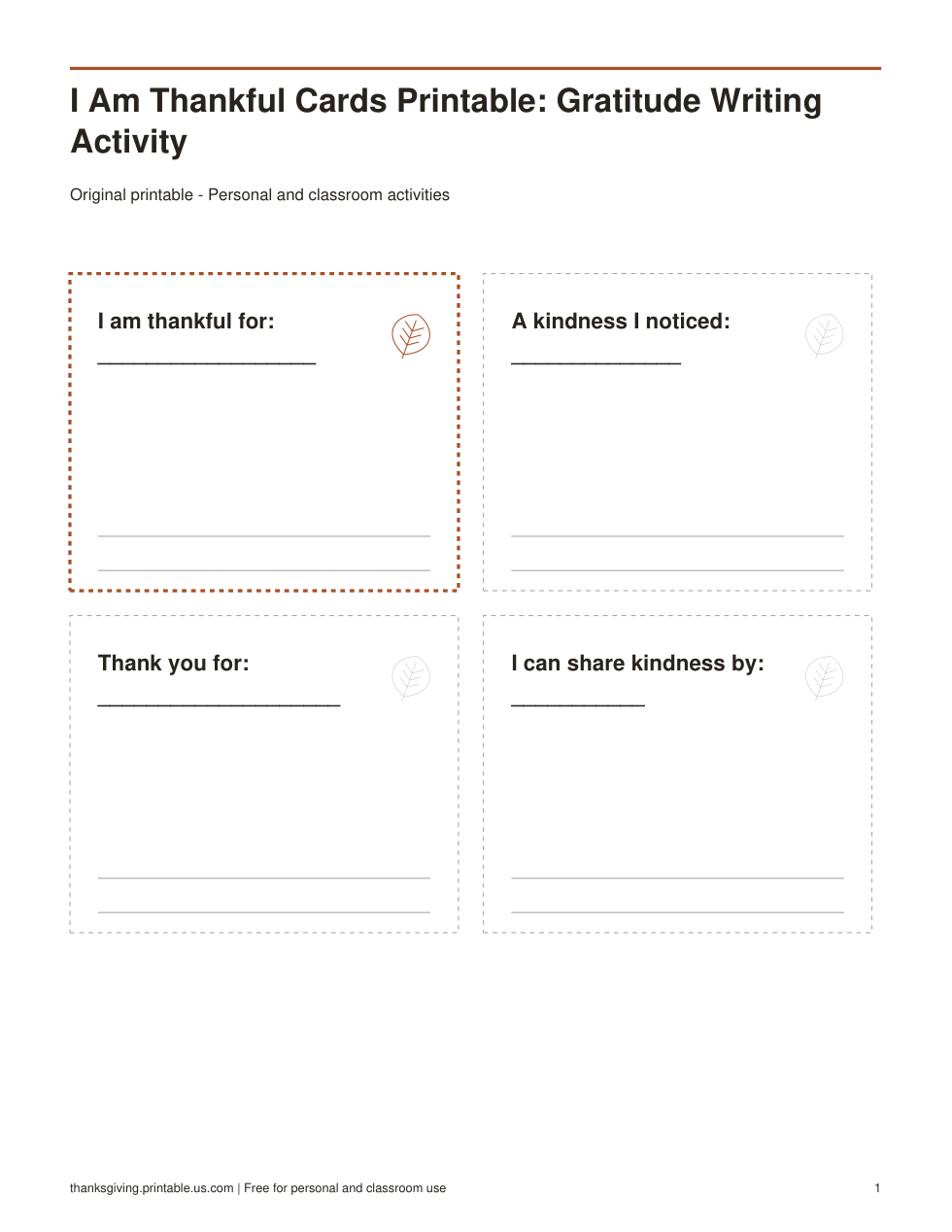
I am thankful cards give a small writing space a clear purpose. Instead of asking for a long essay, invite each person to name something they appreciate and explain why. The printable supplies a gratitude prompt that can be written as a note, attached to a card, or displayed with a paper turkey.
Move from a word to a reason
“Family” or “friends” can be a starting point, but a reason makes the message more personal. Ask a follow-up question: “What did that person do?” or “Which moment are you remembering?” A child may choose a small event such as borrowing a pencil or sharing a book.
- Read the thankful prompt.
- Choose one person, experience, place, or everyday thing.
- Write what you appreciate and add a reason.
- Choose one kind action you could do next.
- Keep the message, give it privately, or add it to a shared display.
Offer a comfortable sharing choice
Some messages feel private. Let children decide whether to read theirs aloud, share only a general idea, or keep the card. A class display can use first names or anonymous notes according to the setting. Focus on the content of the gratitude rather than the length or decoration of the writing.
For a family gathering, place a blank note beside each seat and allow time for quiet writing. For a classroom activity, revisit the notes later and ask whether anyone completed their chosen kind action. Younger children can draw their idea and dictate a sentence. The prompt is open enough to be used at Thanksgiving or at another time when a short thank-you would be welcome.
Frequently asked questions
Are these only for Thanksgiving?
No. The gratitude prompt can be used whenever you want to notice and explain something you appreciate.
Can children draw instead of writing?
Yes. A drawing plus a dictated explanation works well. Preserve the child’s own words when adding the sentence.