Download the free printable
Download PDF (1 page) Download PNG preview
US Letter, 8.5 x 11 inches. Print at 100% for craft pieces; use Fit to page if your printer clips the margins. An adult should help with scissors and fitting wearable crafts.
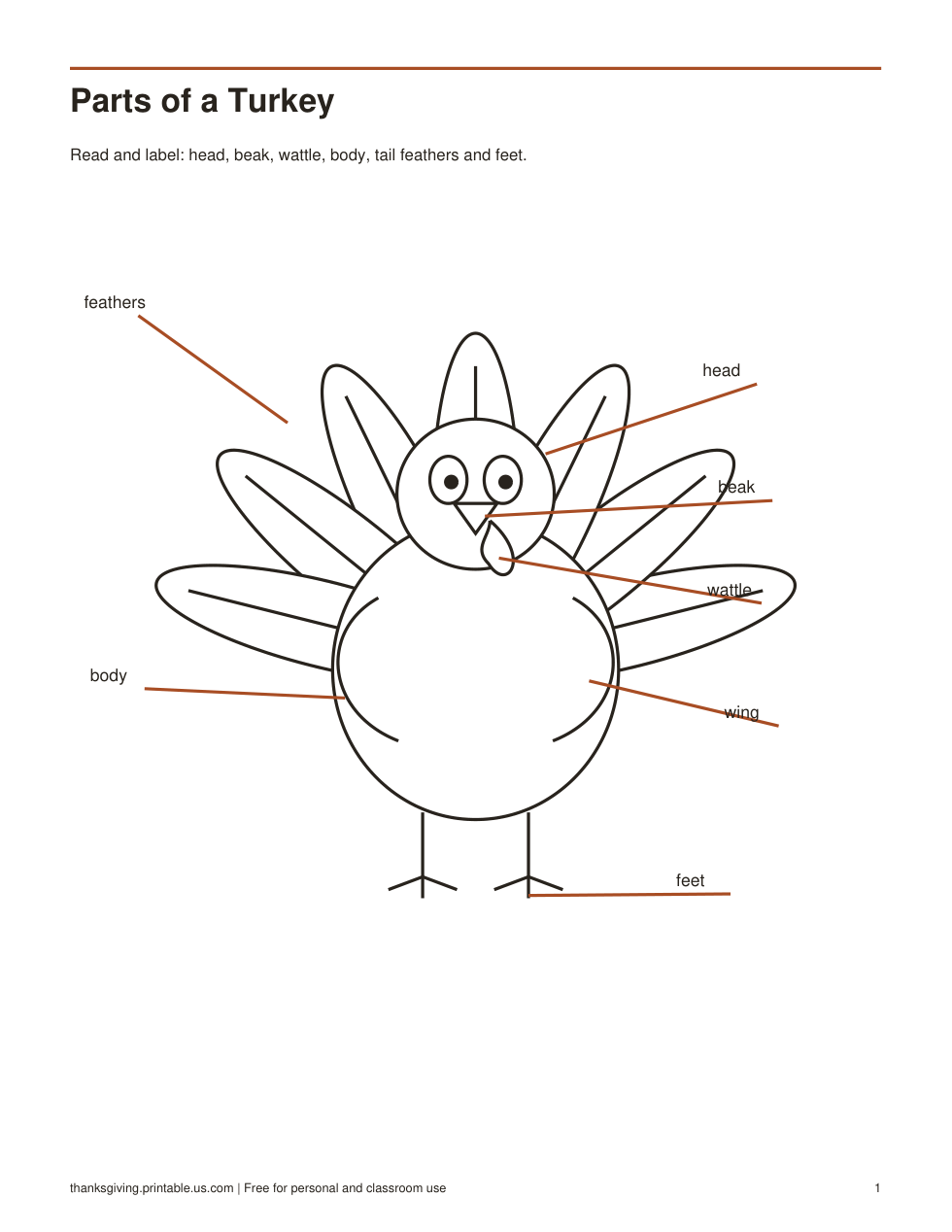
Look closely at a turkey picture and name the features children often overlook. This parts of a turkey activity introduces useful words for the head, beak, wattle, body, tail feathers and feet. It pairs well with a turkey craft because learners can connect each label to a shape they have just colored, traced or assembled. The drawing is a simplified classroom model rather than a detailed anatomy chart.
How to use this printable
- Point to the turkey head, body and feet together. Ask children to describe what they notice before introducing any new terms.
- Read each label and locate the matching part on the picture. Explain that the wattle is the hanging skin beneath the beak.
- Write or trace the labels, then draw a line from each word to its matching feature. Keep the lines apart when possible so the page remains readable.
- Cover the word list and name the parts again. Finish by choosing one part and describing how its shape differs from the neighboring parts.
Make the activity your own
Use a real wildlife photograph alongside the simplified outline when discussing what turkeys look like. Compare the long tail feathers with the smaller wing feathers, or notice that a beak is different from a mammal’s mouth. Younger children can work with only three labels at first. Older students can add an observation sentence that distinguishes something visible in the picture from something they would need to research.
Printing and questions
Print the PDF on US Letter paper in portrait orientation. Start with one copy and check the preview before making a classroom set. Use ordinary paper for a worksheet, or cardstock when the finished piece needs to stand up to handling.
Is a wattle the same as a beak?
No. The beak is the hard mouth structure; the wattle is hanging skin beneath it.
Can the page become a matching game?
Yes. Make separate paper labels and place them beside the picture, then ask children to match each label without drawing lines.