Download the free printable
Download PDF (2 pages) Download PNG preview
US Letter, 8.5 x 11 inches. Print at 100% for craft pieces; use Fit to page if your printer clips the margins. An adult should help with scissors and fitting wearable crafts.
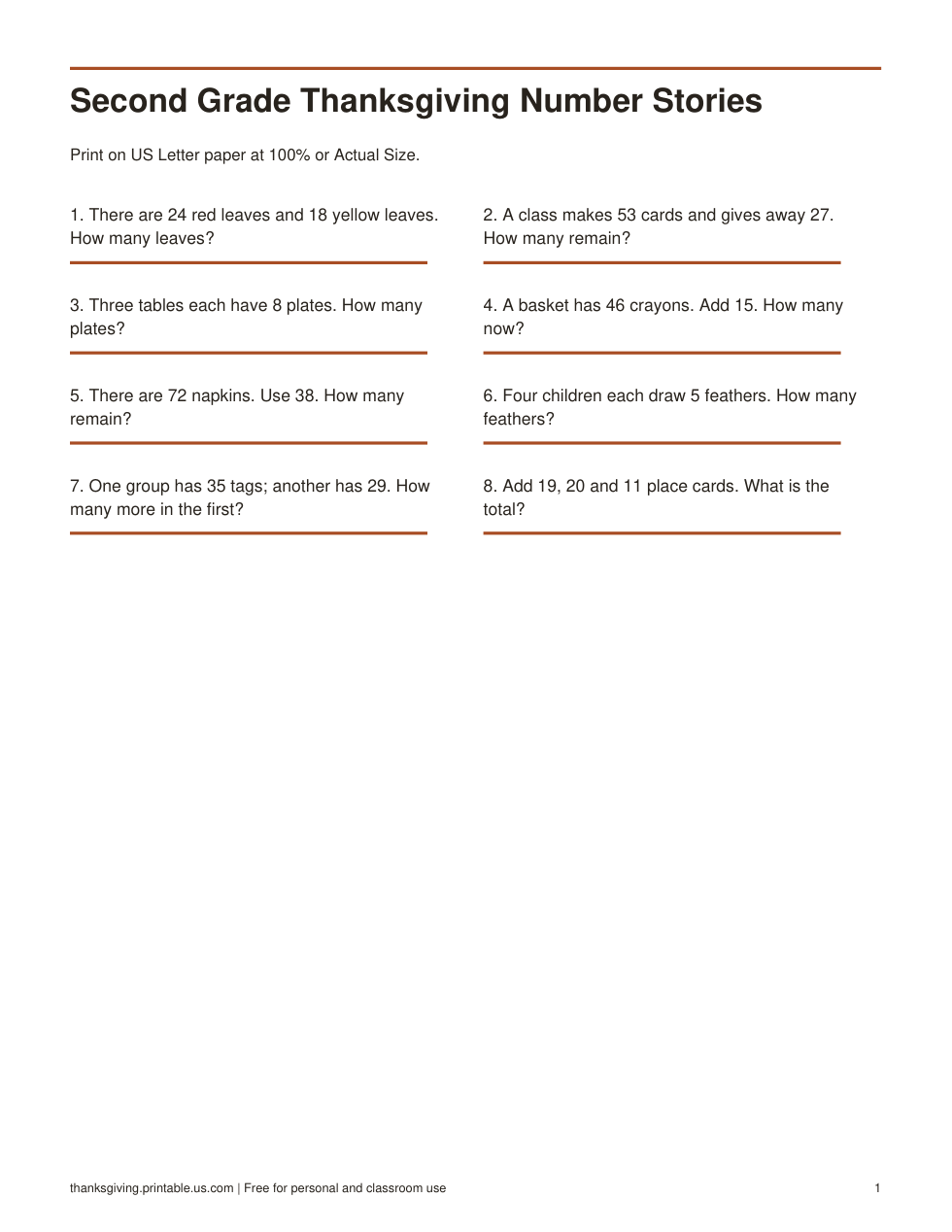
Use a Thanksgiving setting to practice second-grade number sense and short word problems. This worksheet includes addition, subtraction, equal groups described in words and comparing totals. The focus is reading each situation carefully, choosing an operation and showing enough work that another person can follow the solution. Seasonal details provide a context without requiring children to know particular family traditions.
How to use this printable
- Read the first problem aloud and identify what is known. Underline the question so students can separate the story from the calculation.
- Choose a model: a drawing, tens and ones, an equation or a number line. Use one model consistently until the child understands the relationship.
- Solve the problem and label the answer with the unit, such as cards, plates or leaves. Ask whether the result makes sense in the story.
- Check answers after completing a small group of problems. Return to the story when correcting an operation rather than changing only the final number.
Make the activity your own
For partner work, one student can read while the other explains a model; switch roles after each problem. Avoid assuming every learner celebrates Thanksgiving in the same way. The plate, card and leaf stories can be described simply as preparations for a community gathering. Students ready for a challenge can change one number and predict how the answer will change before calculating.
Printing and questions
Print the PDF on US Letter paper in portrait orientation. Start with one copy and check the preview before making a classroom set. Use ordinary paper for a worksheet, or cardstock when the finished piece needs to stand up to handling.
Does the page require multiplication facts?
No. Equal-group situations can be solved with repeated addition or drawings.
How much work should a child show?
Enough to explain the choice of operation. A clear picture or labeled equation can be more useful than several lines of unexplained arithmetic.