Download the free printable
Download PDF (2 pages) Download PNG preview
US Letter, 8.5 x 11 inches. Print at 100% for craft pieces; use Fit to page if your printer clips the margins. An adult should help with scissors and fitting wearable crafts.
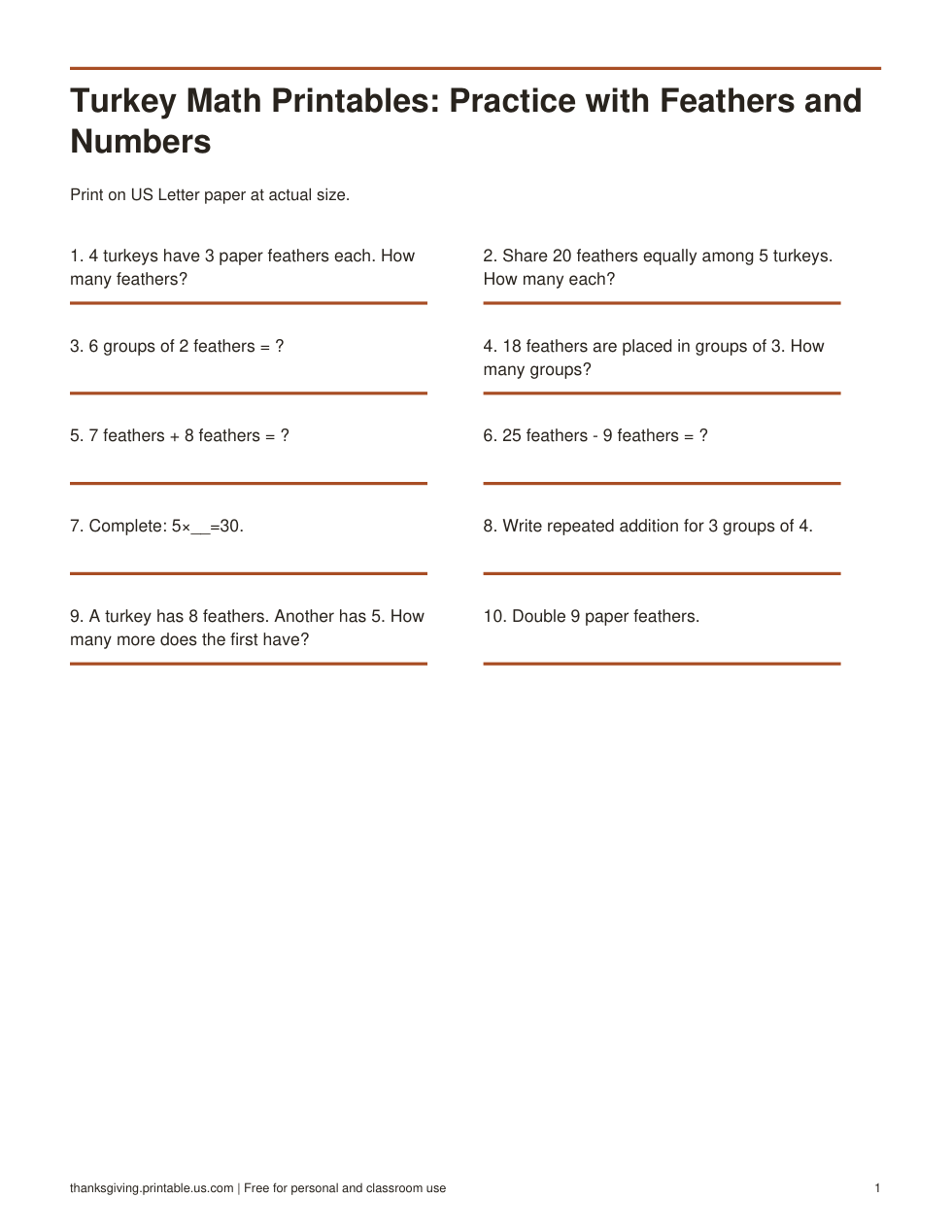
Turkey math printables can turn a feather fan into a model for equal groups and related number sentences. This activity uses original problems with small whole numbers so students can draw, calculate, and explain. Choose the questions that match the learner’s current skills rather than treating every turkey-themed problem as the same level of difficulty.
Build an equal-group model
Draw several paper turkeys with the same number of feathers. Count the feathers on each turkey, then count how many turkeys are in the group. Write a repeated-addition sentence and connect it to multiplication. For example, four turkeys with three feathers each represent 3 + 3 + 3 + 3 and 4 × 3. Ask the learner to label what each number describes.
Connect division to sharing and grouping
Use counters or paper feather shapes to model the division questions. In a sharing problem, distribute a total equally among a stated number of turkeys. In a grouping problem, make groups of a stated size and count the groups. Compare the two interpretations using the same total. Students can draw the arrangement that makes the meaning clearest before writing the final answer.
Check answers with a related fact
After solving a division problem, multiply the quotient by the divisor and compare the result with the starting total. For multiplication, use repeated addition or a small array as a second method. Finish by asking the student to create a feather problem with a clear answer and enough information for a partner to solve it. Review whether the story matches the equation rather than checking the number alone.
Frequently asked questions
Can beginners use the printable?
Select addition and small equal-group tasks, and let the learner use objects. Students who have not studied multiplication can describe the repeated groups before introducing the symbol.
What if a child knows the answer but cannot explain it?
Ask for a drawing or a matching arrangement of counters. Then have the child point to each number in the equation and explain what it counts in the picture.