Download the free printable
Download PDF (1 page) Download PNG preview
US Letter, 8.5 x 11 inches. Print at 100% for craft pieces; use Fit to page if your printer clips the margins. An adult should help with scissors and fitting wearable crafts.
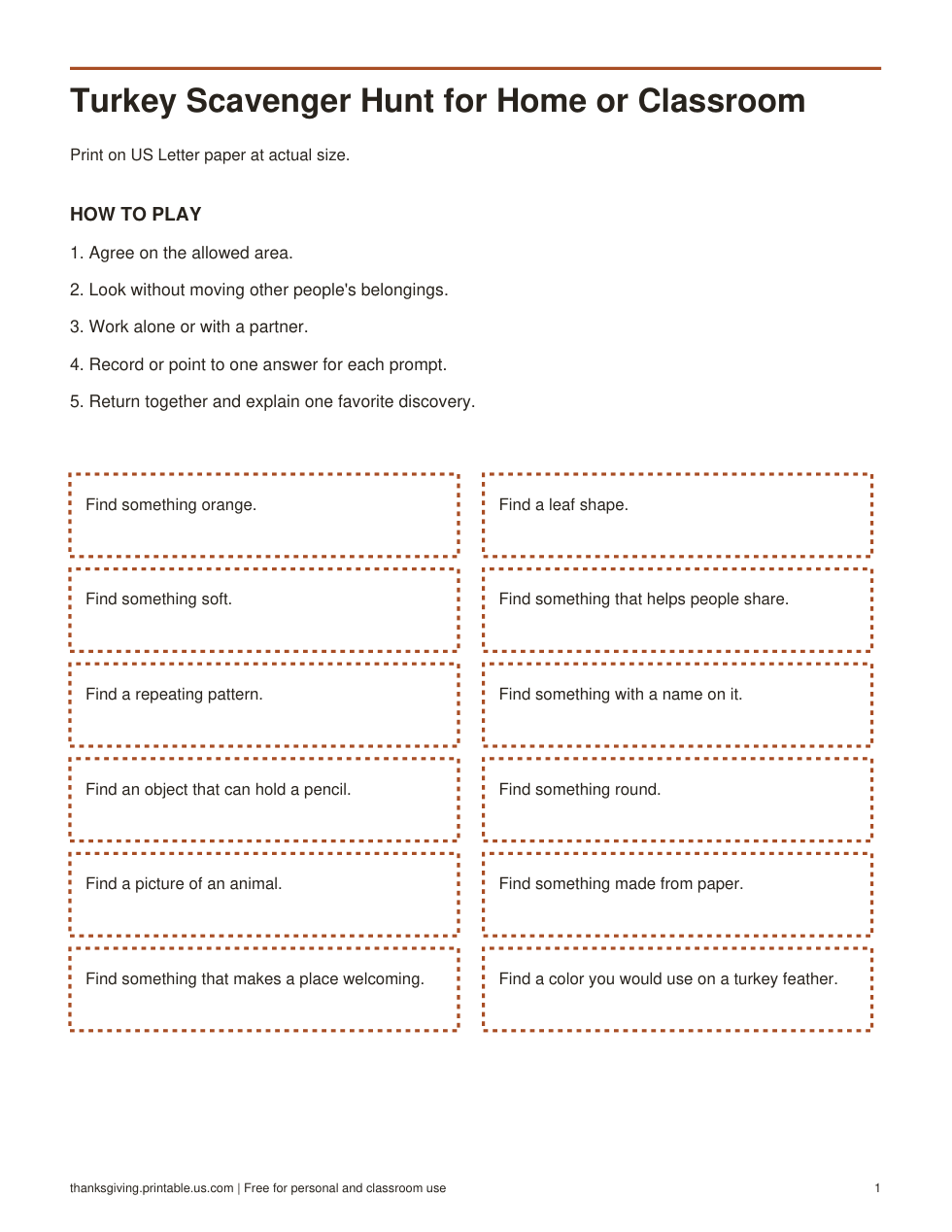
A turkey scavenger hunt gives children a reason to look closely at their surroundings. This version uses observation prompts rather than a race to collect household objects. Players can point, draw, or write what they find, making the activity easy to adapt for a classroom, home, or indoor Thanksgiving gathering with limited space.
Set boundaries before the hunt
Choose the rooms or areas that are part of the game and explain which places are off limits. Keep kitchens in use, private rooms, and storage areas outside the hunt. Decide whether players work alone, in pairs, or with an adult. Read the prompts together so everyone knows that pointing to an object counts; nothing needs to be removed from its place.
Give each clue more than one possible answer
A prompt such as “Find something orange” could lead to a leaf, a book cover, or a drawing. “Find something that helps people share” might produce a serving spoon or a box of crayons. Ask players to explain their choice instead of looking for one hidden official answer. A student who cannot find an example can draw something that would fit and tell the group why.
Finish with a shared discovery
Bring everyone back to the starting spot and invite each team to share one interesting find. Compare different answers to the same prompt. The host can award a group celebration for completing the hunt rather than ranking children by speed. For another round, let players write one new observation prompt and check that it can be answered within the agreed boundaries.
Frequently asked questions
Do I need to hide paper turkeys first?
No. The observation version works with items already in the room. You can add paper turkeys as optional markers if you want a more traditional hide-and-find activity.
How can a guest participate without walking around?
Let a partner describe objects, use a seated viewing area, or bring photographs of possible finds to the table. The guest can choose answers and explain the connections.