Download the free printable
Download PDF (2 pages) Download PNG preview
US Letter, 8.5 x 11 inches. Print at 100% for craft pieces; use Fit to page if your printer clips the margins. An adult should help with scissors and fitting wearable crafts.
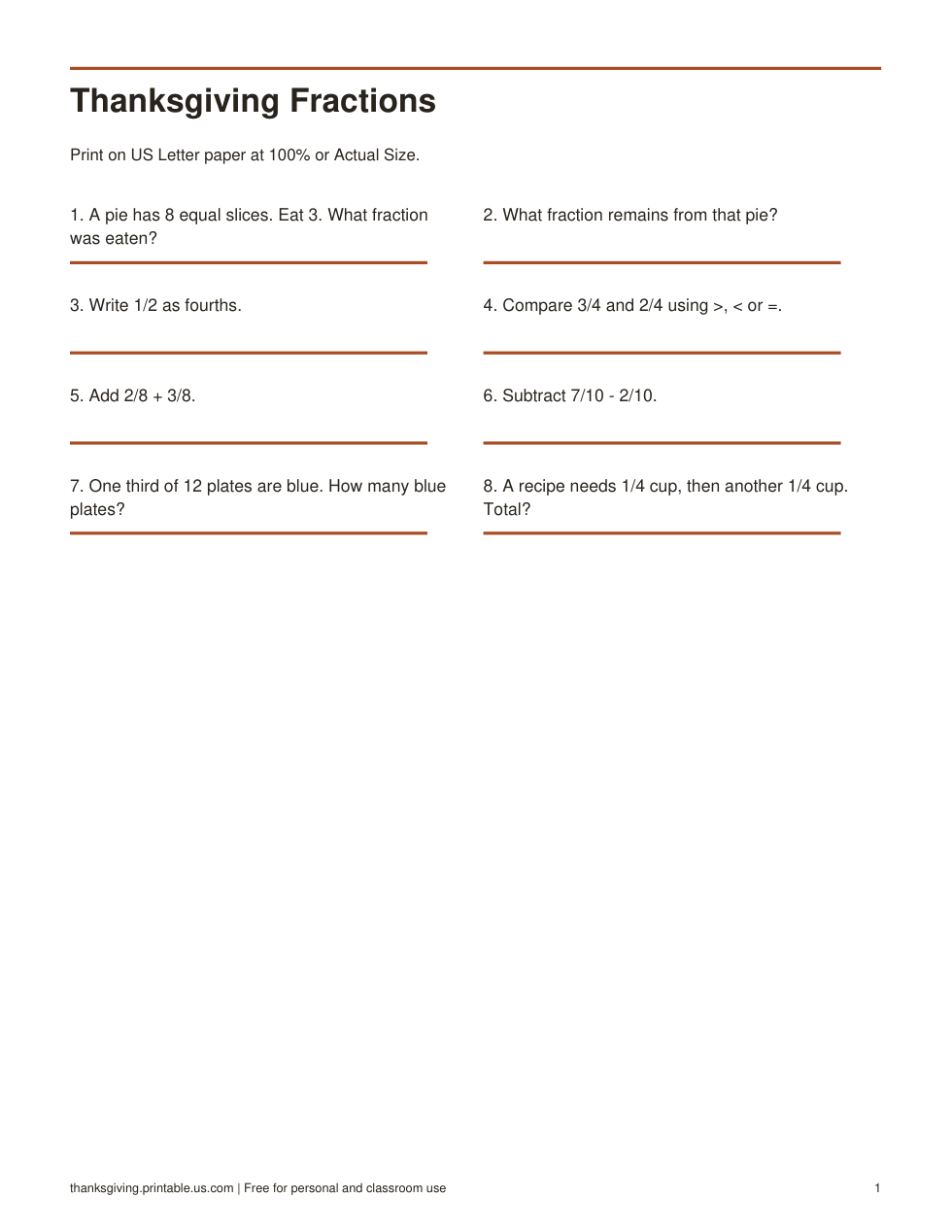
A Thanksgiving fractions worksheet can turn sharing stories into precise mathematical thinking. This page uses pies, recipe amounts and table groups to practice equal parts, equivalent fractions and simple fraction operations. Students should identify the whole before calculating. A fraction has meaning only when the reader knows whether it describes one pie, a set of plates or another complete group.
How to use this printable
- Read each story and name its whole. Draw a bar or circle when that helps show how the parts relate.
- Write fractions with a clear numerator and denominator. Check that each part in the model is equal before counting it.
- Simplify or compare the requested fractions. For addition or subtraction, explain why the denominators must describe matching part sizes.
- Use the answer key to check the calculation and reread the story to check the unit. Correct the model if the written fraction does not match it.
Make the activity your own
Use paper strips to demonstrate equivalence before relying on a rule. Folding a strip into halves and fourths shows why one half equals two fourths. For a small group, let each student explain a different model for the same problem. The numbers are deliberately manageable so learners can focus on meaning, including the distinction between a fraction of one object and a fraction of a collection.
Printing and questions
Print the PDF on US Letter paper in portrait orientation. Start with one copy and check the preview before making a classroom set. Use ordinary paper for a worksheet, or cardstock when the finished piece needs to stand up to handling.
Which fraction skills are included?
The page covers identifying parts, equivalent fractions, comparisons and simple operations with common denominators.
Can students draw instead of using a formal algorithm?
Yes. A correct equal-part model with a clear explanation is an appropriate way to reason through these problems.