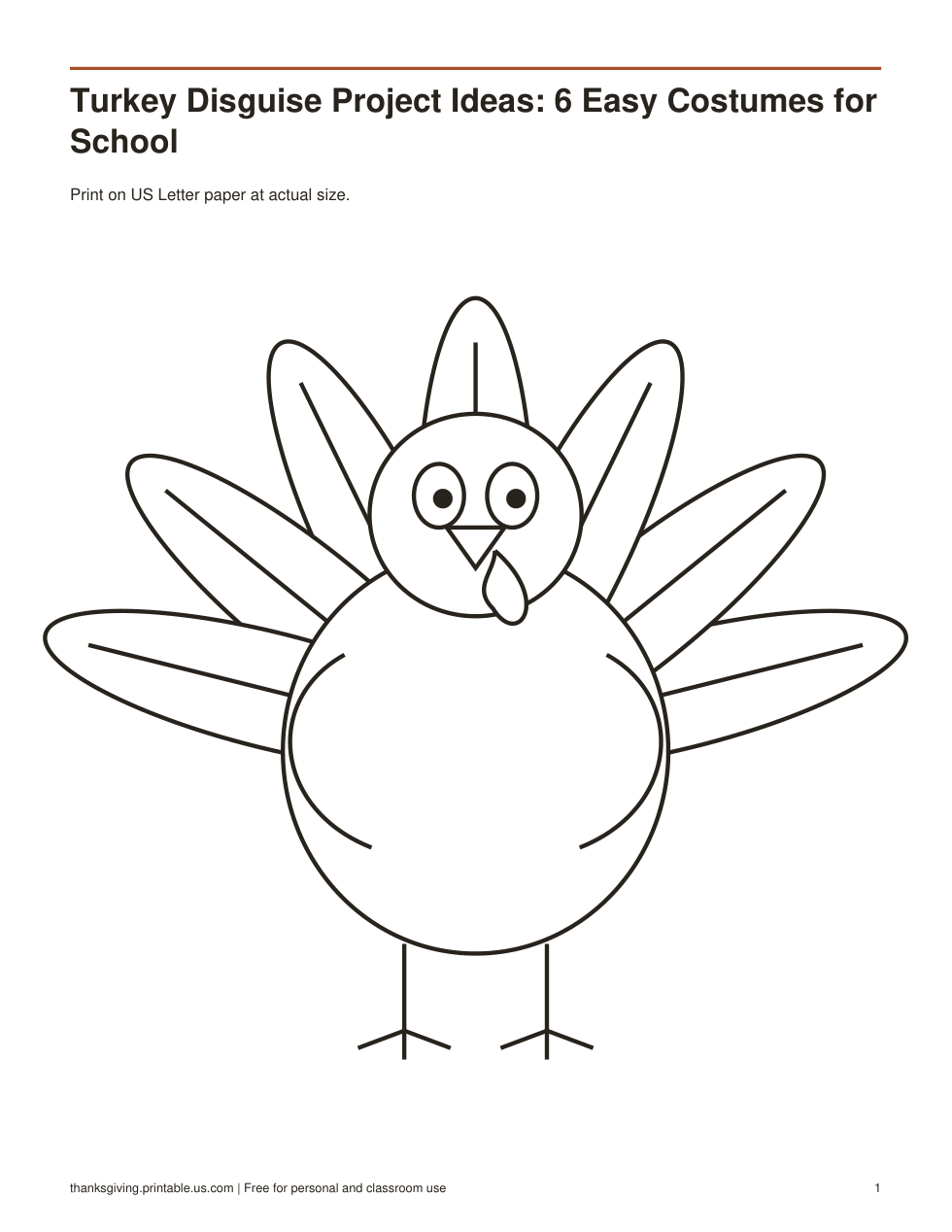
Download the free printable
Download PDF (1 page) Download PNG preview
US Letter, 8.5 x 11 inches. Print at 100% for craft pieces; use Fit to page if your printer clips the margins. An adult should help with scissors and fitting wearable crafts.
A turkey disguise project starts with a funny problem: how can a paper turkey hide in plain sight? Give children a turkey outline, a few ordinary craft supplies, and permission to choose their own solution. These turkey disguise project ideas emphasize recognizable shapes, manageable construction, and a short explanation written in the child’s own words.
Choose a costume with a clear silhouette
A chef needs a tall white hat and apron. An astronaut can wear a round paper helmet and a rectangle backpack. A flower uses large petals around the face. A rainbow hides the tail beneath colored paper strips. A librarian carries a folded paper book. A delivery driver wears a cap and holds a small cardboard parcel. Pick one main feature before adding details.
Build the disguise in three layers
First, color the turkey body and set it aside. Next, cut the costume’s largest shape from scrap paper and hold it over the body to check the fit. Finally, attach small details such as buttons, pockets, or a badge. Keep glue away from the outer edge until everything lines up. An adult can prepare difficult cuts while the child chooses colors and placement.
Add a convincing cover story
Ask the child to finish: “I am not a turkey. I am a ___ because ___.” A good explanation points to something visible on the costume. For example, the librarian can say, “I brought a book for story time.” Display the sentence beside the finished craft, then invite classmates to identify the clues. Children can revise one detail after hearing a partner’s guess.
Frequently asked questions
What if we only have crayons and plain paper?
Draw the costume directly on the outline, then add one separate paper accessory. A hat alone can establish a character without a complicated collage.
Should the turkey’s feathers be completely covered?
They can remain visible if the child explains them creatively. Feathers might become flower petals, rocket flames, or the background behind a stage performer.